
Why Apple fell after a beat. How traders prepare for earnings.
Peak Performance Trading · · 7 min read
Stocks fall after good earnings when the report is good but not as good as the market already expected, or when the outlook for next quarter is weaker than hoped. The price going into a report already holds a forecast. What moves the stock is the gap between that forecast and the new information, and guidance usually carries more new information than last quarter's numbers.
What happened with Apple
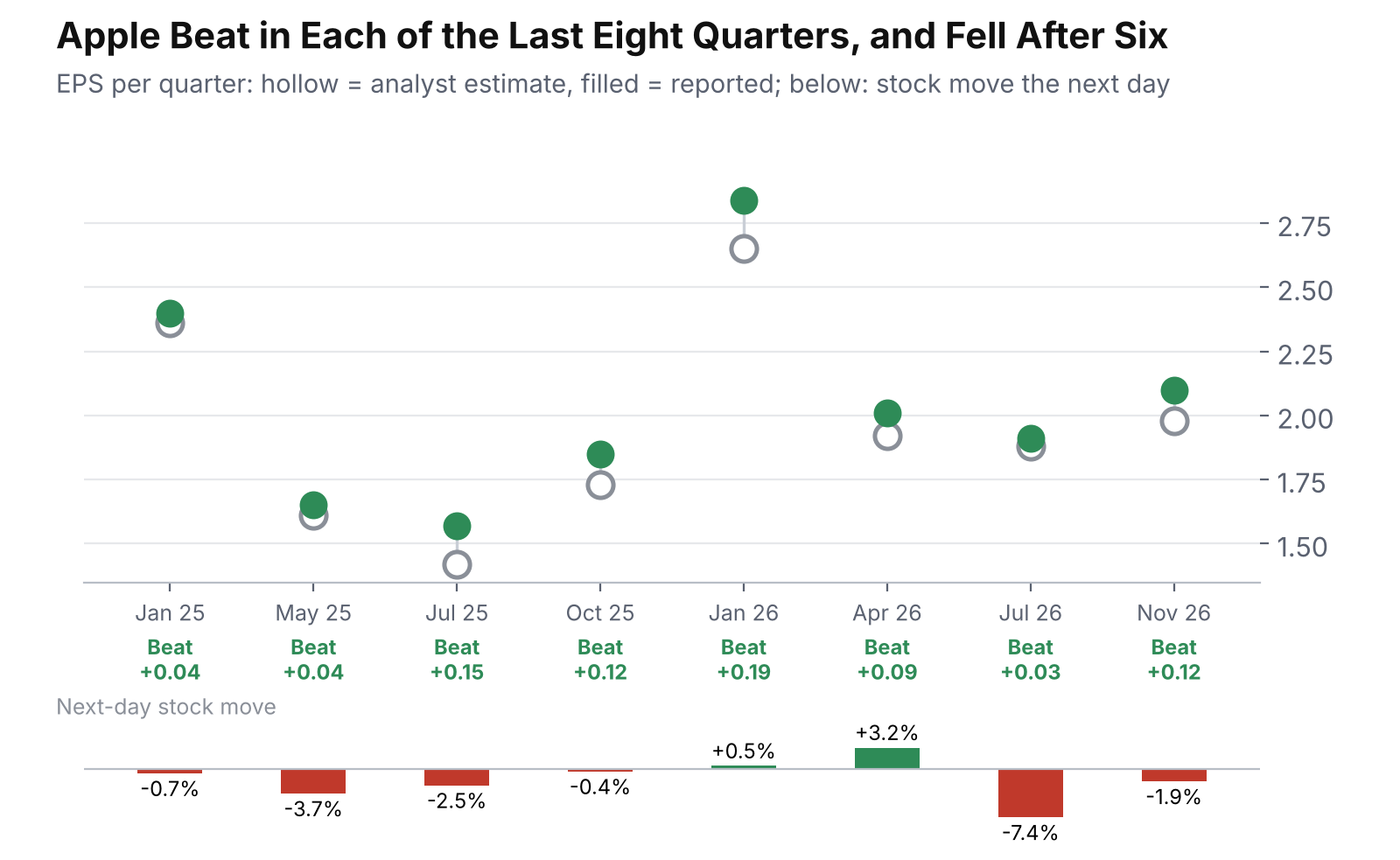
Apple reported after the close on Monday, 2 November 2026. Revenue came in at $114.48 billion, up 12% from a year earlier, and earnings per share at $2.10. Both beat analyst estimates. iPhone and Services revenue set September-quarter records.
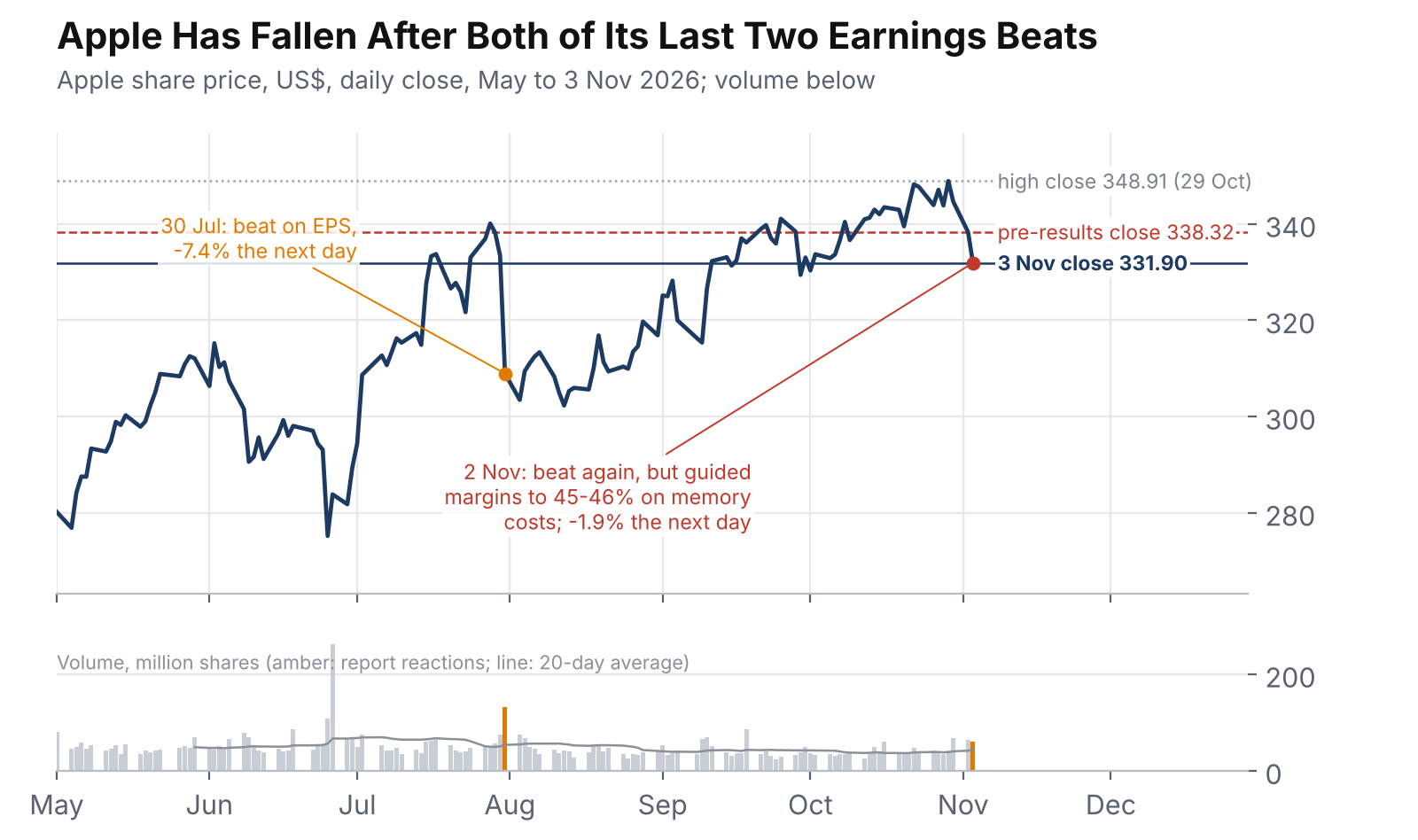
Then management guided December-quarter gross margin to 45%-46%, below the 46%-47% analysts expected, and blamed rising memory-chip costs. The stock fell 4.7% before the next open. It closed 1.9% lower on 3 November.

The mechanism
A share price is the market's current estimate of a company's future profits. An earnings report changes that estimate in two ways.
First, it shows the quarter that just ended. That's history. Analysts have been modelling it for months, so most of it is already in the price. A small beat on numbers everyone expected to be good adds very little.
Second, it changes the outlook. Guidance, margins and what management says about costs tell the market what the next few quarters look like. That's where the new information sits.
Apple's history was strong. Its outlook said the company would keep less of every dollar it sells, and management said the memory cost pressure would carry on beyond December. So the market cut its estimate of future profits and the price fell, even though the quarter was a record.
This is why "beat or miss" is a weak way to read earnings. The better question: did this report change what the market expects for the next year?
What's priced in before the report
Several layers of expectation are already in the price before a company reports.
Consensus. This is the average analyst estimate for revenue and EPS. Apple's was about $113.46 billion in revenue and $2.00 in EPS. Beating it is the minimum, not the surprise.
Whisper numbers. Large companies usually beat consensus, and traders know it. So the unofficial expectation, often called the whisper number, sits above the published one. A beat that only matches the whisper isn't news.
Positioning and run-up. If a stock has rallied into the report, holders are already set up for good news. That leaves fewer new buyers when it arrives.
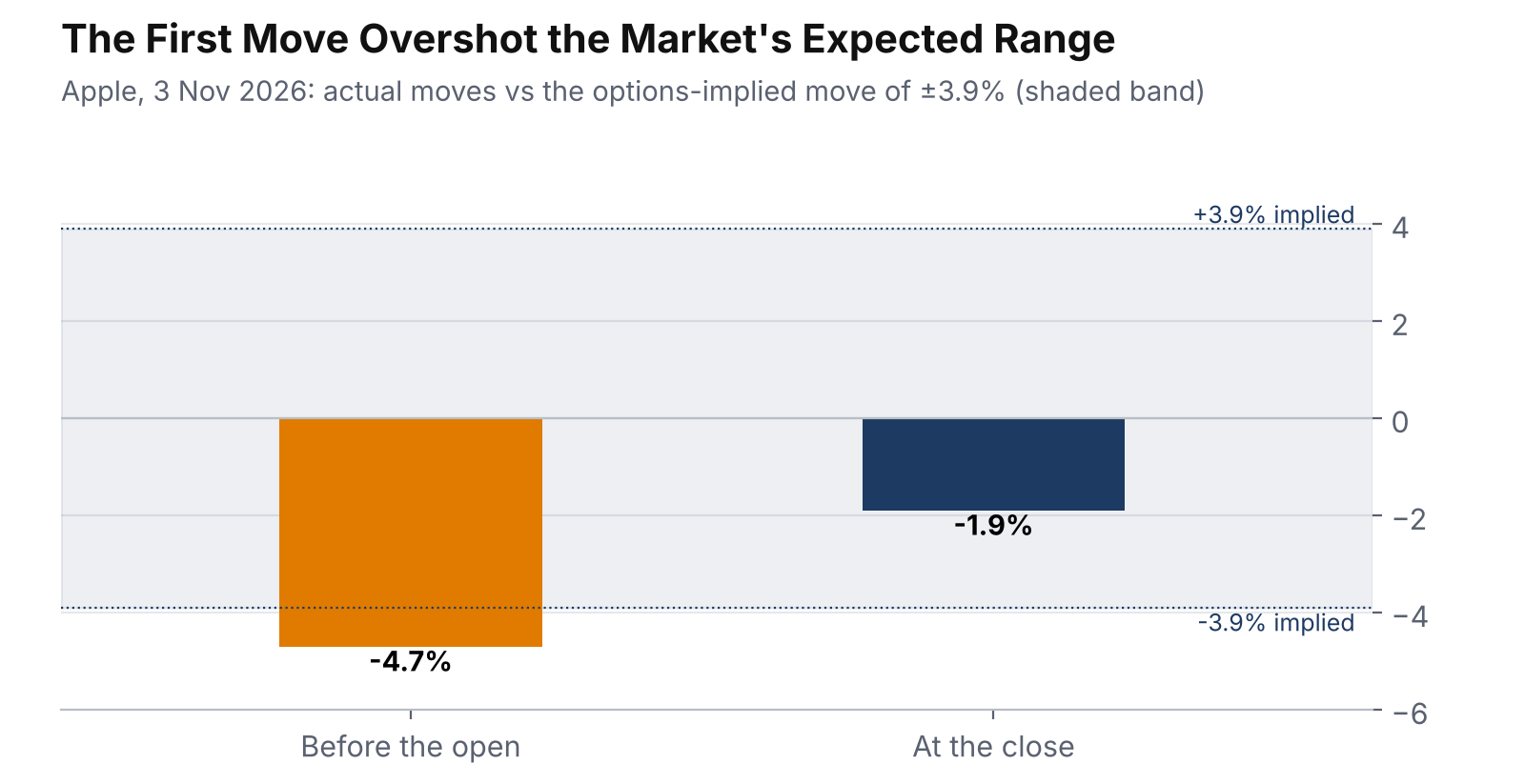
The implied move. Options traders price how far the stock might move after the report. For Apple, options priced about 3.9% in either direction on report day, down from about 4.3% a week earlier. That's an expected range, not a call on direction. Apple's 4.7% pre-market drop went past it. By the close the loss was 1.9%, about half.
The quarter before looked the same. On 30 July 2026 Apple also beat the EPS estimate ($1.91 against $1.88), and the stock fell 7.4% the next day. Both times, the beat on its own told you very little.
There's a lesson in that pre-market overshoot too. The first reaction after earnings often goes too far. It happens in thin pre-market trading, before anyone has digested the conference call and before larger investors act. The first move isn't always the last one.
How experienced traders prepare
Experienced traders treat an earnings report as a scheduled risk event. Most of their decisions are made before the release, not during it.
1. Decide whether to hold through the report. A position held overnight through earnings can gap straight past your stop. A stop doesn't protect you from a gap: it becomes a market order at the next available price. If a gap the size of the full implied move would break your risk limit, the position is too big to hold through.
2. Write your scenarios before the release. For example (illustrative): "Beat with weaker guidance: I expect a gap down and do nothing in the first 30 minutes. Beat with stronger guidance: I look for a pullback that holds above the prior day's high. Miss: I stay out until the conference call is over." You aren't trying to predict. You're deciding in advance what you'll do in each case, so you don't have to decide under pressure.
3. Know what the market is watching this time. With Apple it was margins and memory costs, not iPhone units. Read what analysts flagged before the report. It tells you which line in the release will move the stock.
4. Size for the gap, not your normal stop. If you do hold through, size the position so a move of the full implied range costs no more than your usual planned risk per trade. That usually means a much smaller position than normal.
5. Let the first reaction settle. Spreads are wide before the open, and the call often changes the tone. Many traders let the first 30 to 60 minutes of the regular session pass before they act.
6. Staying out is a valid plan. If you can't define your risk, you don't have to trade the event. You can watch how the stock reacts and use what you learn next quarter.
Four checks that cut through the noise
Check the index first. For a very large company, a big share of any day's move comes from the market as a whole. Compare the post-earnings move with the index before you read anything into it. On 3 November the Nasdaq 100 rose 0.7% while Apple fell 1.9%. That gap is the part that belongs to Apple's own news.
Read the guidance before the past quarter. The quarter that ended is history. The outlook is new. Apple's record revenue was largely expected, and the margin guide wasn't. When the headline and the guidance point different ways, the guidance usually wins.
Treat the reaction as two verdicts. The after-hours move reacts to the headline on thin volume. The next regular session reacts to the full picture: the call, analyst notes, full volume. Apple was down about 4.7% before the open and closed 1.9% lower. When the two disagree, the second carries more weight.
Follow the costs down the chain. One company's cost is another's revenue. Apple's memory problem is the memory makers' pricing power. On the same day AMD rose about 8% after hours on a strong outlook. Reading a report well means asking who else it touches, and which way.
Common mistakes on earnings
- Reading only the headline. "Apple beats" was true, and still a poor reason to buy. The guidance line mattered more.
- Holding full size through the report. One gap can do the damage of several normal losing trades.
- Trusting the stop. Overnight, price jumps. Your stop fills wherever the market opens.
- Chasing the pre-market move. Apple's pre-market low was well below its close. Acting on the first number often means acting at the worst price.
- Mistaking the reaction for the trend. One day's move shows how the market judged the report. It doesn't tell you where the stock goes over the next month.
- Arguing with the price. "But they beat" isn't a reason to buy a falling stock. The market is showing you what it cared about.
Your earnings-day checklist
Run through these before the next report you trade or hold:
- What's consensus, and what does the market really expect (the whisper)?
- What's the options-implied move, and could I live with a gap that size?
- Which line will the market focus on this time: revenue, margins, guidance, a region, a product?
- What are my three scenarios, and what do I do in each?
- Am I holding through the report? If so, is my size set for the gap rather than my normal stop?
- How long will I wait after the open before I act?
- Afterwards: did I follow the plan, and what did the reaction teach me about what the market cared about?
Getting feedback on your plan
Writing the plan is half the work. The other half is checking whether you stuck to it. In private 1-on-1 trading mentoring, a mentor reviews your earnings plan before the report and your decisions after it, so you can see where your process held and where it slipped.
FAQ
Why do stocks fall after beating earnings?
Because the price already included a beat. What moves a stock is new information, and most of it sits in guidance, margins and management's outlook. If the outlook is weaker than expected, as with Apple's margin guidance in November 2026, the market lowers its estimate of future profits and the price falls despite a strong quarter.
What is earnings guidance?
Guidance is the company's own forecast for coming periods: revenue growth, margins, costs. It matters because it changes how analysts model future profits. Apple guided December-quarter gross margin to 45%-46%, below expectations, and that one line pushed the stock lower even though revenue and earnings beat.
Should you hold a position through earnings?
Only if a gap of the full expected move fits inside your risk limit. Stops don't protect against overnight gaps; they fill at the next price. Many traders cut size, close before the report, or wait and trade the reaction instead. Make that call in your plan before the report, not after it.
What is an earnings implied move?
It's the move options prices suggest for the stock after earnings, in either direction. It comes from the cost of at-the-money options that expire just after the report. Before Apple's November 2026 report, options priced about 3.9%. It shows the expected size of the move, not its direction.
How do traders prepare for earnings day?
They check consensus and the implied move, find out which metric the market is focused on, write scenarios with a planned action for each, and size so a gap fits their risk. Many wait 30 to 60 minutes after the open before acting. Some simply stay out.
For the numbers behind Apple's quarter and the market reaction, read the Prime Terminal update on Apple's earnings.
Education and mentoring. No trading guarantees.