
How geopolitical news moves oil. And why gold fell when oil did.
Peak Performance Trading · · 8 min read
Geopolitical events move oil mostly through risk: the chance that supply gets cut off. When that risk rises, traders pay a premium above what current supply and demand justify, and when it eases, the premium comes out of the price, often faster than it went in. Gold reacts to the same events, but in 2026 it has been following interest rates more than fear.
Oil and gold in early November 2026
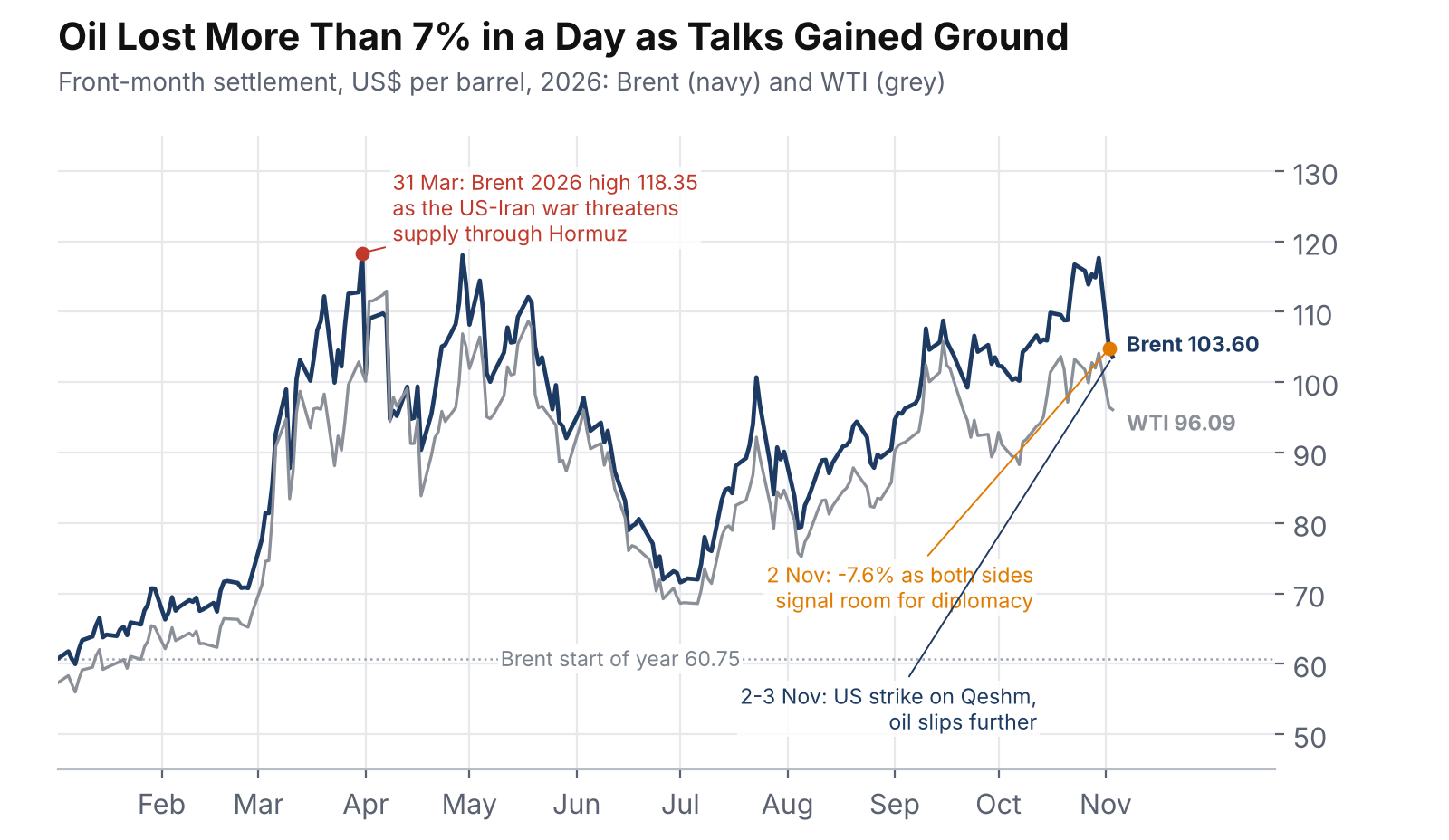
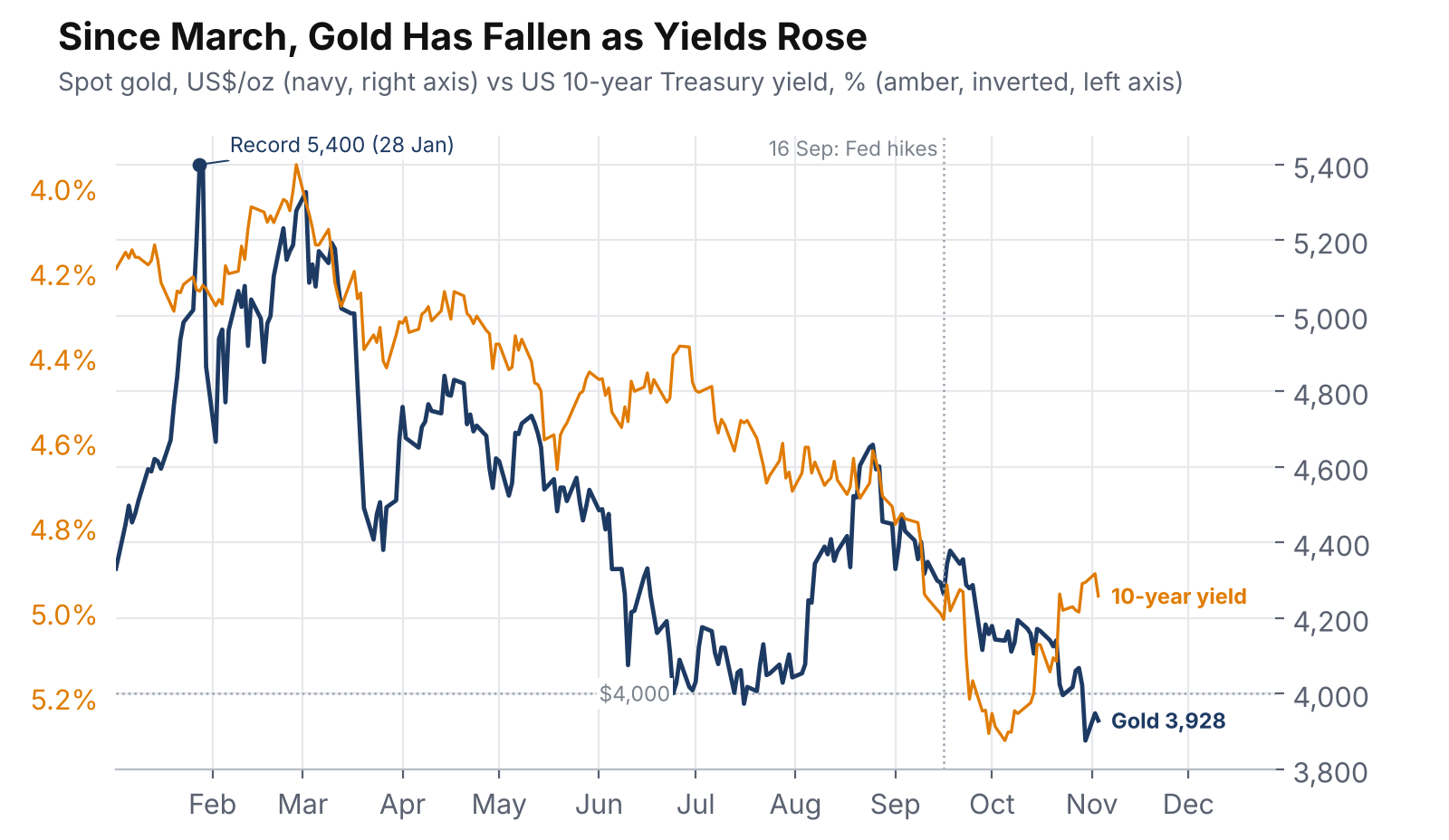
On Monday, 2 November 2026, oil fell more than 7% in a single session as the US and Iran signalled room for diplomacy. Late that evening the US struck an anti-aircraft facility on Iran's Qeshm Island, and President Trump called it "a minor attack." Oil still slipped, with Brent near $103 and WTI near $96. Spot gold fell 0.5% to about $3,927 as Treasury yields rose. It's down roughly 6% over 20 sessions.
What a risk premium in oil is
Think of the oil price in two parts.
The first is the physical market: how much oil gets produced, shipped and used. It changes slowly.
The second is the risk premium, the extra buyers will pay to protect themselves against a supply shock. If a large share of the world's oil might not get through a strait, refiners and airlines buy ahead and hedge. Speculators buy because they expect others to. That premium can be large, and it lives on expectations rather than barrels.
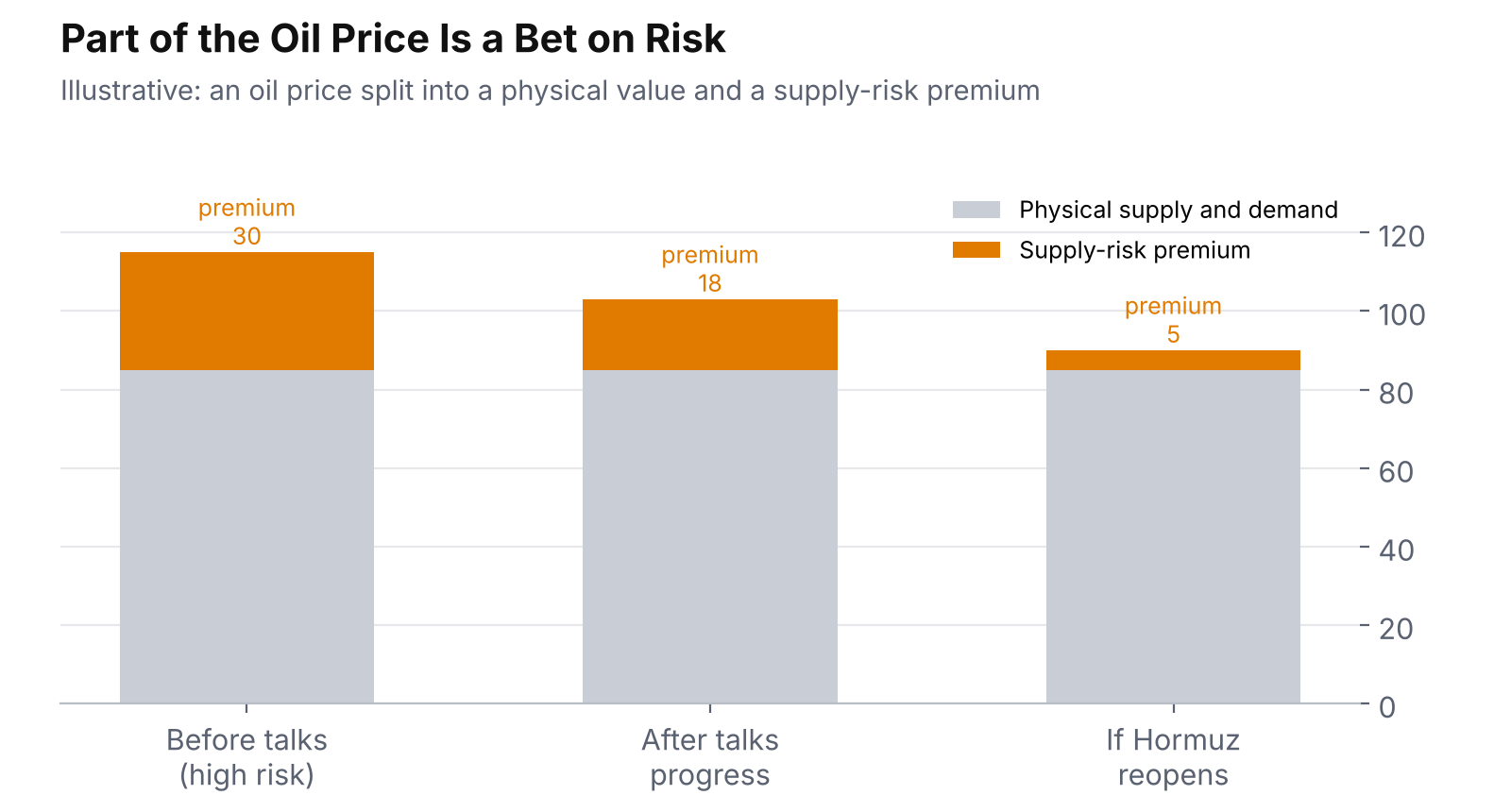
So oil can fall 7% in one day without a single extra barrel being produced. Nothing physical changed on 2 November. The market's estimate of the risk changed, and the premium shrank.
It's also why the Qeshm strike barely moved oil. Earlier in the conflict, a US strike would have added to the premium. This time the market read it as pressure inside a negotiation it expects to succeed. The same kind of headline can push the price in opposite directions, depending on what's already priced.
Why gold can fall when oil falls or rises
Many traders expect gold to rise whenever there's conflict. It often does on the first day. Over weeks, though, a second driver tends to be stronger: interest rates.
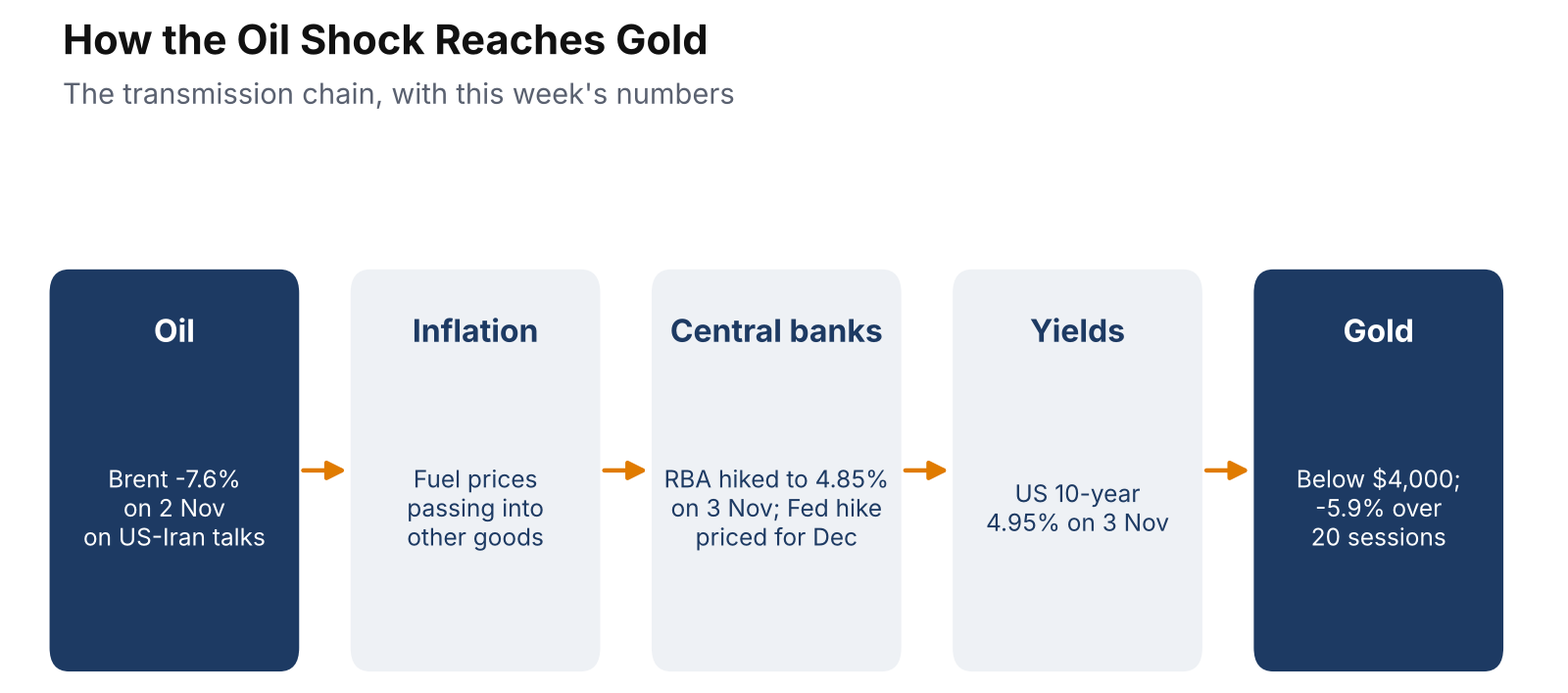
Gold pays no interest. When yields rise, holding it costs more, because you give up the interest you could earn elsewhere. The chain looks like this:
- Oil rises on supply risk.
- Fuel and transport costs push inflation up.
- Central banks raise rates to contain inflation. On 3 November the Reserve Bank of Australia raised its cash rate to 4.85% and named higher fuel prices from the Middle East conflict as a reason.
- Higher yields make gold less attractive.
Now run it in each direction:
- Tensions ease: safe-haven demand for gold fades. Gold can dip.
- Tensions stay high: oil keeps inflation up, central banks keep hiking and yields rise. Gold can dip.
That's how gold ended up below $4,000 while a war was still unresolved, after trading above $5,000 in March. Gold isn't broken. You just need to know which driver the market is trading right now, and in early November 2026 that's rates. The US 10-year yield rose to 4.95% on 3 November, and markets priced a strong chance of a Fed hike in December.
Headline volatility vs trend
Headlines create fast moves. Trends need a change in the underlying story.
A headline move is the market adjusting to new information in minutes or hours. It often overshoots, and a second headline can reverse it the same day. In a negotiation, statements from both sides, mediators and unnamed officials arrive constantly.
A trend comes from a change that keeps working on the price for weeks. For oil, that would be a signed deal that reopens a shipping route, or a breakdown that takes supply away for longer. For gold, it would be a shift in what central banks are expected to do.
Before you act on a headline, ask one question. Does this change the story, or only the mood?
Why chasing headlines is expensive
Trading the first seconds after a headline looks attractive because the moves are big. In practice it's one of the most expensive ways to trade.
- Spreads widen. Liquidity providers pull back when news hits, so you pay more to get in and out.
- Slippage grows. Your order fills further from the price you saw.
- Reversals are common. A headline is often clarified, denied or overtaken within hours.
- It invites revenge trading. One fast loss on a headline often leads to a second, larger trade to win it back. That's where most of the damage happens.
You're also up against algorithms that read and trade headlines faster than any person can.
How traders plan for unscheduled news
You can't know when the next headline comes. You can decide in advance what you'll do when it does.
1. Set your risk before the news. If you hold oil or gold exposure while a conflict is live, size it so that a move like the 7% drop on 2 November doesn't break your limits. Treat gaps and fast moves as normal.
2. Don't add on headlines. Adding to a position because a headline went your way is how a planned trade turns into an unplanned one. If you want more exposure, decide it at a calm moment, for a reason that will still hold tomorrow.
3. Write scenarios for the big outcomes. For example (illustrative): "If a deal is signed and a reopening date is named, I expect oil's risk premium to fall further, and I will not hold long oil exposure into that. If talks collapse with strikes on energy infrastructure, I expect the premium to return, and I will wait for the second reaction before acting." The scenario tells you what to look for. It doesn't tell you what will happen.
4. Wait for the market's second reaction. The first move shows you the surprise. The second, after follow-up comments and once you can see who's buying and selling, shows whether the story changed. Many traders wait at least until the next session.
5. Check the other market. If oil falls on peace hopes but gold rises, the market may be trading safe-haven demand. If both fall while yields rise, it's trading rates. Knowing which driver is in charge keeps you from drawing the wrong conclusion.
Words versus barrels
A practical filter for oil headlines: does the news change how many barrels reach the market? Statements, threats and strikes on military targets usually move the price briefly, if at all. Actions that touch supply, such as a closed shipping lane, damaged export terminals or attacks on tankers, change the premium and can move it for weeks. The Qeshm strike hit an air-defense site. Brent rose about 1% on the first reports and gave it back the same day.
Check the data against expectations
A number on its own tells you little. An inventory draw matters if it's bigger than expected and nothing bigger is moving the price. On 3 November, US crude stocks fell more than forecast and oil still traded lower, because the premium leaving the market outweighed it. When strong data doesn't lift the price, something else is in charge.
Look at positioning
Before a sharp move, ask who's exposed. In late October, speculators held one of the smallest net long positions in WTI futures in the history of the data, even with Brent above $100. A fall in a market where few speculators are long is less likely to turn into forced selling. Positioning data comes out weekly with a three-day delay, so treat it as background rather than a timing tool.
Seasonality is a tie-breaker
Some seasonal patterns have a real cause. In October and November many refineries shut for maintenance and switch to winter fuel, which lowers their demand for crude for a few weeks. A pattern like this can support a view you already hold. It should never be the only reason for a trade.
Common mistakes with geopolitical news
- Assuming conflict always means higher oil. What matters is the change in supply risk compared with what's priced.
- Assuming conflict always means higher gold. In a rate-driven market, gold can fall during a war.
- Trading the first spike. Wide spreads and fast reversals make it expensive.
- Adding to positions on each new headline. Your risk grows while the information stays thin.
- Ignoring scheduled events. Central bank decisions and inflation data can matter more than the headline you're watching.
Your geopolitical news checklist
- What is the market pricing right now: escalation or a deal?
- Does this headline change the story, or only the mood?
- Which driver is gold trading this week: fear or rates?
- Is my position sized for a 5-10% move in a day?
- Have I written down what I'll do if the outcome is a deal, a stalemate or a breakdown?
- Am I about to add on a headline? If so, stop and write down why.
- Have I waited for the second reaction?
A second view on your news plan
Most headline mistakes happen in the minutes after the news hits, which is exactly when nobody is checking your reasoning. In private 1-on-1 trading mentoring, a mentor reviews your plan for event risk before it happens and goes through your decisions with you afterwards.
FAQ
How do geopolitical events affect oil prices?
Mostly through the risk premium, the extra traders pay for protection against a supply disruption. When the risk rises, the premium grows. When talks progress, it shrinks. In November 2026, oil fell more than 7% in one day on hopes for US-Iran diplomacy, with no change in physical supply.
Why does gold move with oil?
Through interest rates. Higher oil pushes inflation up, central banks raise rates, and higher yields make gold, which pays no interest, less attractive. When tensions ease, gold also loses safe-haven demand. That's why gold fell below $4,000 in early November 2026 while oil was falling too.
Should you trade breaking news?
For most traders, not in the first minutes. Spreads widen, fills slip, reversals are common and you're competing with algorithms. A better approach is to size your exposure for news in advance, then act on the market's second reaction, once it's clear whether the story actually changed.
What is a risk premium in oil?
It's the part of the oil price that pays for the possibility of a supply shock, rather than for current supply and demand. Because it runs on expectations, it can appear or disappear quickly. A move toward a deal that would reopen a key shipping route removes part of it, often within days.
How do traders handle headline risk?
They set position size before the news, avoid adding on headlines, write scenarios for the main outcomes and wait for the second reaction before acting. They also check related markets such as gold and yields to see which driver is in charge. Staying flat during a live negotiation is a valid choice too.
For the market side of the same story, read the Prime Terminal update on oil, gold and the US-Iran talks.
Education and mentoring. No trading guarantees.